Strategic Sourcing Process: 7 Steps, Templates and Examples
A strategic sourcing process connects the business need to supplier selection, negotiation, implementation, and measured results. These seven steps give buyers a repeatable route while keeping evidence and approval responsibilities visible.
Strategic sourcing is a structured way to choose how an organization will meet a business need through suppliers. It combines demand, market alternatives, total cost, risk, and execution planning. Purchasing carries out an approved transaction; sourcing establishes whether the requirement, supplier approach, and commercial arrangement make sense.
Different decisions, complementary work
Question
Purchasing focus
Strategic sourcing focus
What are we buying?
Order the specified item or service.
Test demand, specifications, and viable alternatives.
What is a good price?
Check the quoted or contracted price.
Compare equivalent scope, whole-life cost, and leverage.
When is the work complete?
Receive and pay for the order.
Confirm outcomes and revisit assumptions over the lifecycle.
A low-risk repeat purchase may need only established purchasing controls. A critical software replacement with migration, renewal, and continuity exposure needs a broader sourcing decision. Scale the work to the decision rather than running a large event for every request.
Seven steps, with a decision at each handoff
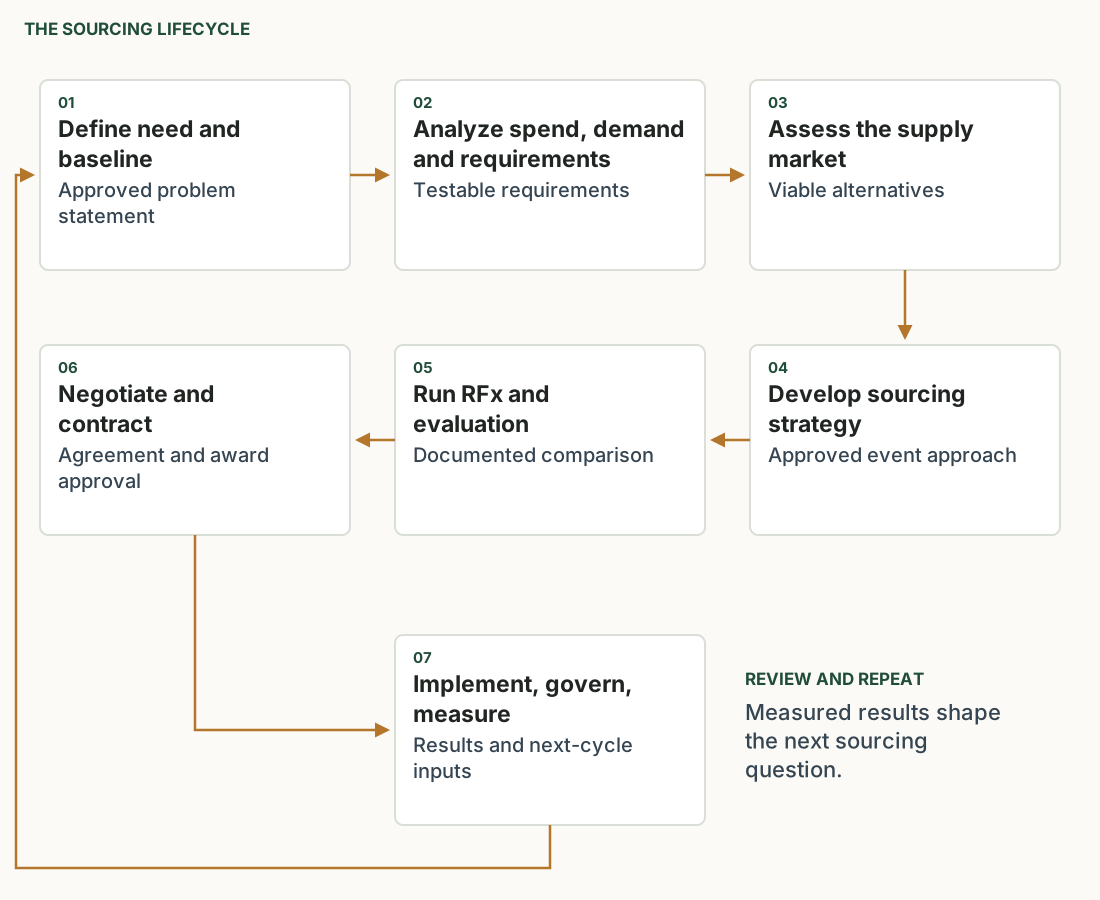
The full sourcing lifecycle. Governance and measured results feed the next cycle; new evidence can also reopen earlier decisions. Open full-size diagram
This is Sourcing Playbooks’ practical buyer-side sequence, not a claim that one universal seven-step standard applies to every organization. Some activities run in parallel, and new evidence can send a team back to requirements or market analysis.
1. Define the business need and baseline
Describe the business outcome before naming a product. Identify the decision owner, contract deadlines, current service problems, and the cost of doing nothing. Agree what is outside scope; an unresolved scope boundary will become a pricing dispute later.
Inputs: Business request, current contract, service history
Output: Approved problem statement and baseline
Decision right: Business sponsor approves scope and accountable owner.
2. Analyze spend, demand and requirements
Reconcile invoices, entitlements, usage, and forecast demand. Separate essential requirements from preferences and specify how suppliers will demonstrate them. For software, named users, active users, environments, and API volumes may produce very different commercial models.
Decision right: Finance validates the baseline; functional owners approve requirements.
3. Assess the supply market
Compare supplier segments and alternatives, not just familiar names. Test availability, implementation capacity, concentration, switching barriers, and evidence quality. Record what is observed, what a supplier claims, and what needs validation.
Decision right: Sourcing determines whether competition is credible.
4. Develop the sourcing strategy
Choose the route: competitive event, targeted negotiation, phased transition, extension, or a justified single-source approach. Set evaluation criteria, pricing scenarios, negotiation objectives, and fallback options before supplier proposals influence them.
Inputs: Baseline, market findings, constraints
Output: Approved event and commercial strategy
Decision right: Sponsor approves the route and resources; risk owners review exceptions.
5. Run the RFx and evaluate suppliers
Use an RFI when material market questions remain; use an RFP when suppliers can respond to a sufficiently clear requirement. Issue consistent clarifications. Evaluate mandatory gates before weighted scoring, normalize proposals, and test claimed capabilities with evidence.
Output: Evaluated options and documented recommendation
Decision right: Evaluators score within their remit; sourcing moderates discrepancies.
6. Negotiate and contract
Negotiate the complete economic and delivery position: price basis, scope, implementation, service levels, renewal, termination, and transition. Convert material promises into the appropriate contract documents and resolve conflicting schedules before signature.
Decision right: Authorized approvers accept the award; legal and risk owners review their areas.
7. Implement, govern and measure results
Assign an implementation owner, acceptance criteria, invoice controls, service measures, and renewal calendar. Compare actual consumption and performance with the approved baseline. Feed missed assumptions and new demand into the next sourcing decision.
Inputs: Signed scope, transition plan, baseline
Output: Operational handoff and measured results
Decision right: Service owner accepts delivery; finance validates realized value.
How this relates to our preparation playbooks
The existing playbook library uses seven preparation stages: intake, category profile, market scan, supplier discovery, cost drivers, shortlist strategy, and event readiness. Those stages deepen the early work in this full lifecycle; they are not a second name for the same seven steps.
Use the preparation worksheets mainly during steps 1–4 and to establish readiness for step 5. RFx execution, negotiation, contracting, implementation, and performance governance then carry the decision forward. The Full Sourcing Playbook System remains focused on connected sourcing preparation artifacts.
Roles and decision rights
Assign authority before contacting suppliers
Role
Owns
Must not be assumed
Business sponsor
Business outcome, resources, and authorized commercial decision
Sourcing cannot silently accept a changed business requirement.
A supplier discount is not automatically realized savings.
Technical and service owners
Fit, integration, acceptance, ongoing service
A successful demo is not proof of production readiness.
Legal, security and privacy reviewers
Review within their assigned authority and escalation of exceptions
An aggregate score cannot override an unresolved mandatory gate.
Record each approval, its scope, conditions, and date. If the evaluation reveals a major requirement change, return it to the requirement owner rather than rewriting criteria to favor the preferred supplier.
Enterprise software purchase: an illustrative process example
A fictional multi-site business needs a common service-management platform. Its existing applications create duplicate work, but consolidating immediately would exceed the integration team’s capacity. The sponsor therefore defines a phased rollout as a requirement rather than treating it as a post-award problem.
The team reconciles users and current costs, investigates three viable providers, and runs a common workflow demonstration. Security and export capability are mandatory gates. Weighted evaluation compares functionality, three-year TCO, implementation feasibility, and support. Negotiation focuses on migration acceptance, subscription start dates, renewal pricing, and usable data export.
The award is conditional on an approved integration plan and contract closure. Quarterly governance checks adoption, duplicate-license retirement, and support outcomes. A delayed legacy shutdown changes the cost forecast and becomes an input to the next review. See the completed scenarios and worked evaluation for the assumptions and award logic.
Common process failures
RFx before alignment: suppliers price different assumptions. Fix the requirements and response template before comparing price.
Incumbent comfort mistaken for evidence: assess alternatives and transition costs before deciding competition is impractical.
Weights changed after bids arrive: retain the approved rubric, or transparently reset the event if the business need changes.
Negotiation limited to discount: evaluate scope, usage, implementation, renewal, and exit obligations together.
Signature treated as the finish line: assign implementation and measurement owners before award.
Buyer-side readiness checklist
The business need, baseline period, and scope exclusions are approved.
Demand assumptions and mandatory requirements have named owners.
The supplier-market assessment distinguishes evidence from claims.
The event route, evaluation rubric, and fallback options are documented.
Pricing comparisons use equivalent quantities, scope, and timing.
Legal, security, privacy, and operational exceptions have an approval path.
The award recommendation explains tradeoffs and conditions.
Implementation acceptance, value measurement, and renewal ownership are assigned.
No. Organizations group the work differently. This seven-step model is a practical editorial structure; retain the decisions and evidence even when local stage names differ.
Does every sourcing project require an RFP?
No. Use the market evidence, scope, risk, and buying constraints to choose the route. Document why a targeted negotiation, extension, or other approach is appropriate.
How long should strategic sourcing take?
Build the schedule backward from the required service date, allowing for evidence gathering, supplier response, approvals, negotiation, and transition. Complexity and readiness matter more than a universal timetable.
Where do templates fit?
Templates organize inputs, assumptions, and approvals. They support the process but cannot replace the buyer’s market assessment or accountable decisions.