Intake and scope control
Sourcing request checklist, decision-owner map, source-material check, and readiness gate.
Full system
A complete sourcing playbook system connecting the buyer-side workflow from intake through sourcing-event readiness for teams that need editable artifacts, visible evidence, documented assumptions, and human review gates before supplier decisions move forward.
Commercial package path
The free starter kit demonstrates the structure. The full system is the natural commercial path: a broader set of editable playbook assets, implementation notes, license boundaries, and optional category adaptation for internal teams or advisor use.
The system is intentionally focused on sourcing preparation: intake, strategy, market intelligence, supplier discovery, cost-driver review, shortlist planning, event readiness, and AI-use governance.
System modules
Each module is designed to produce a reviewable artifact that can be handed to a sourcing lead, business owner, finance partner, or specialist reviewer.
Sourcing request checklist, decision-owner map, source-material check, and readiness gate.
Category profile, business objectives, demand and spend assumptions, and sourcing question framing.
Supplier segment map, market factors, source notes, confidence ratings, and evidence gaps.
Supplier universe, fit signals, constraints, known gaps, and validation questions.
Cost-driver worksheet, assumption log, evidence status, and finance-review questions.
Shortlist rationale, hold/remove logic, unresolved questions, and reviewer notes.
Go/no-go checklist before formal bidding, renewal, negotiation, or vendor-management activity.
Source material, AI-supported output, human review performed, decision impact, and status.
Workbook preview
The screenshots show the style of the starter kit and the type of fields that can be expanded in a full package.
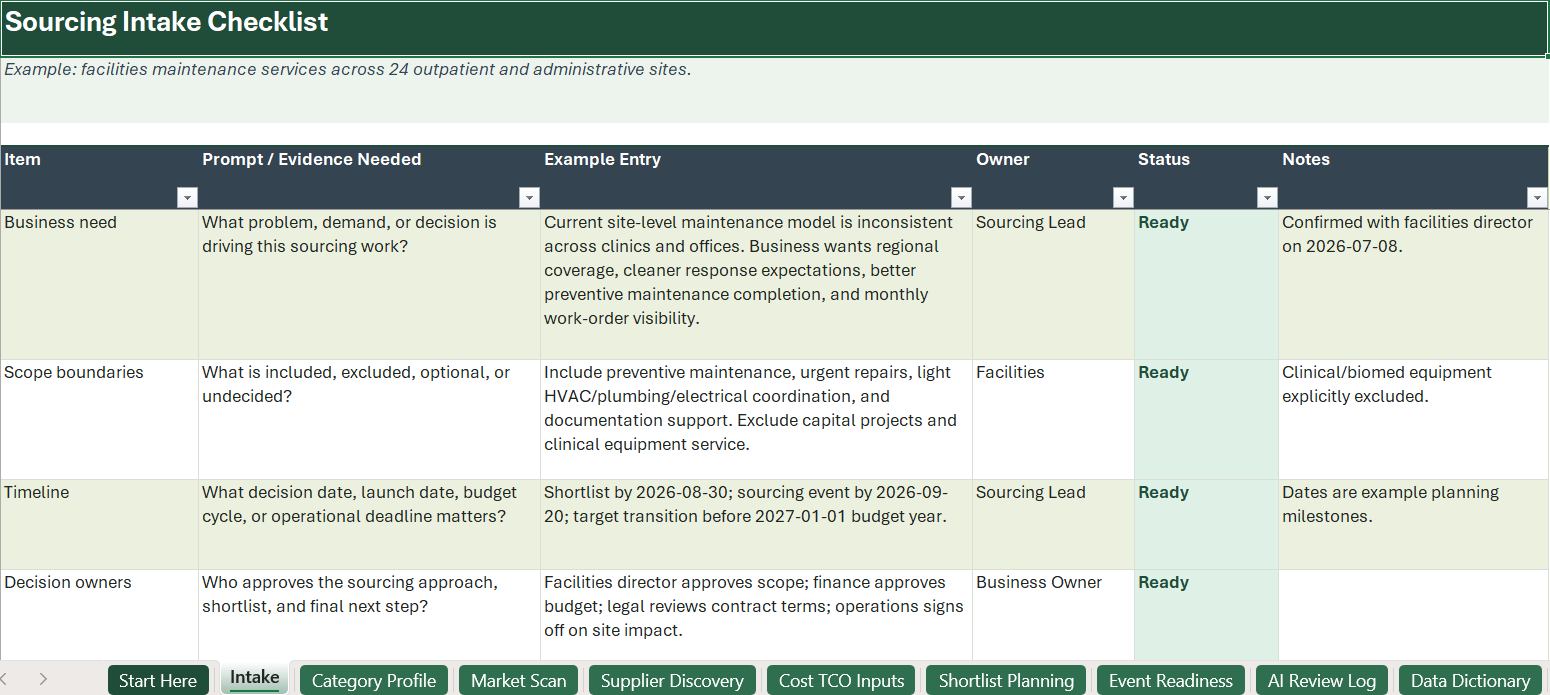 Enlarge preview
Clarifies: Business need, scope boundaries, timing, decision owners, known constraints, source material, and readiness gates.
Supports: Whether the request is ready for market scan and supplier discovery.
Useful fields: Owner, status, notes, evidence prompts, and example entries make it a reviewable sourcing packet rather than a blank form.
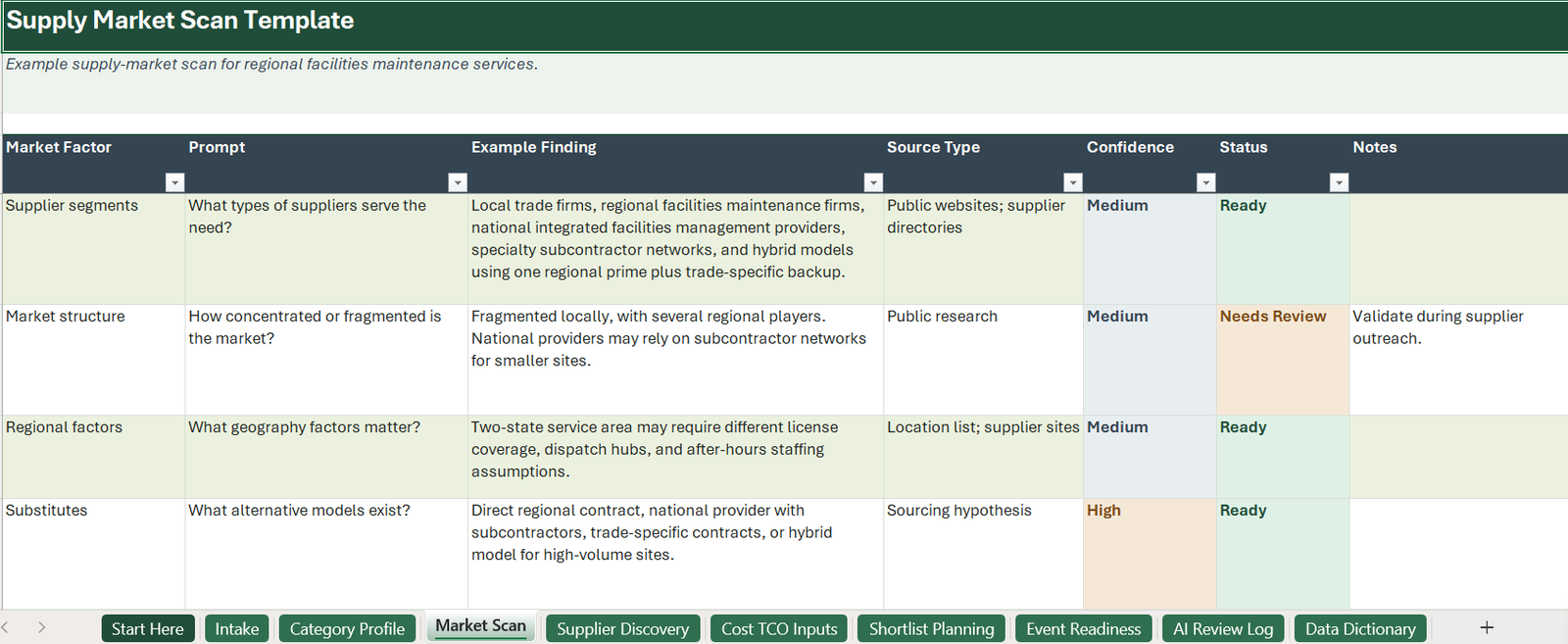 Enlarge preview
Clarifies: Supplier segments, market structure, regional factors, substitutes, capacity signals, cost pressure, and evidence quality.
Supports: Whether the team has enough market intelligence before supplier outreach.
Useful fields: Source type, confidence, status, and notes help separate observed evidence from assumptions.
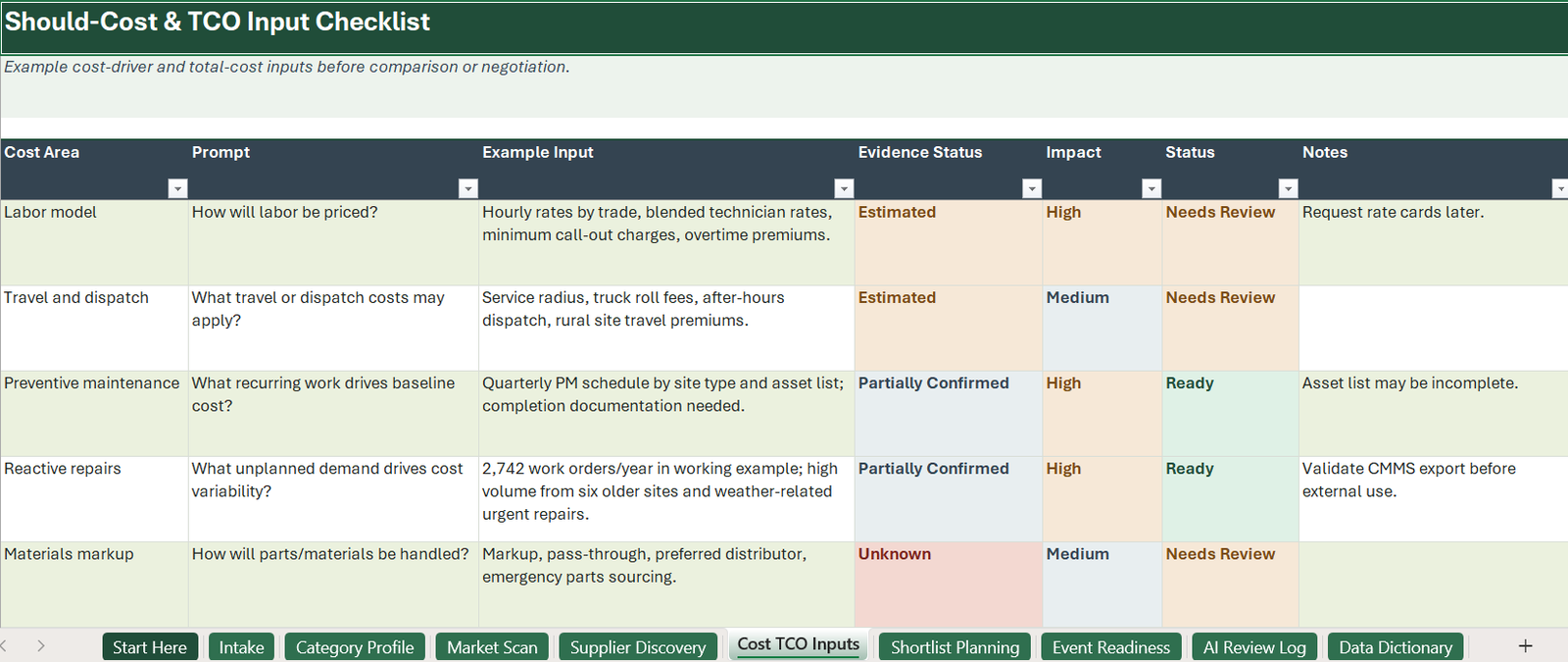 Enlarge preview
Clarifies: Labor model, travel and dispatch, preventive maintenance, reactive repairs, materials markup, reporting, and switching friction.
Supports: Whether cost-driver assumptions are ready for finance review before shortlist approval.
Useful fields: Evidence status, impact, readiness, and notes show which costs are known, estimated, or still unresolved.
Package paths
Exact scope and rights should be confirmed before any commercial use, internal rollout, advisory delivery, or branded version.
The materials are independently developed and should be kept free of employer-confidential, client-confidential, patient, protected health, or proprietary third-party information. Public examples are illustrative and should not be treated as customer case studies.
Updates should preserve readability, editable formats, version labels, source-grounded evidence fields, and human-review points.
Category demonstration
The fictional IT sourcing demonstration shows how the same system can be applied to managed services or software support sourcing while keeping examples generic and safe for public use.
Next step
The free kit shows the workflow. The full package discussion can cover team use, advisory use, category-specific adaptations, and implementation support.