Buyer-side resource
AI Strategic Sourcing: Buyer-Side Workflow, Use Cases and Controls
AI can help sourcing teams organize evidence, compare options, and prepare decisions. The buyer still needs to validate the analysis and retain authority over awards, contracts, commitments, and material risk.
A human-governed workflow

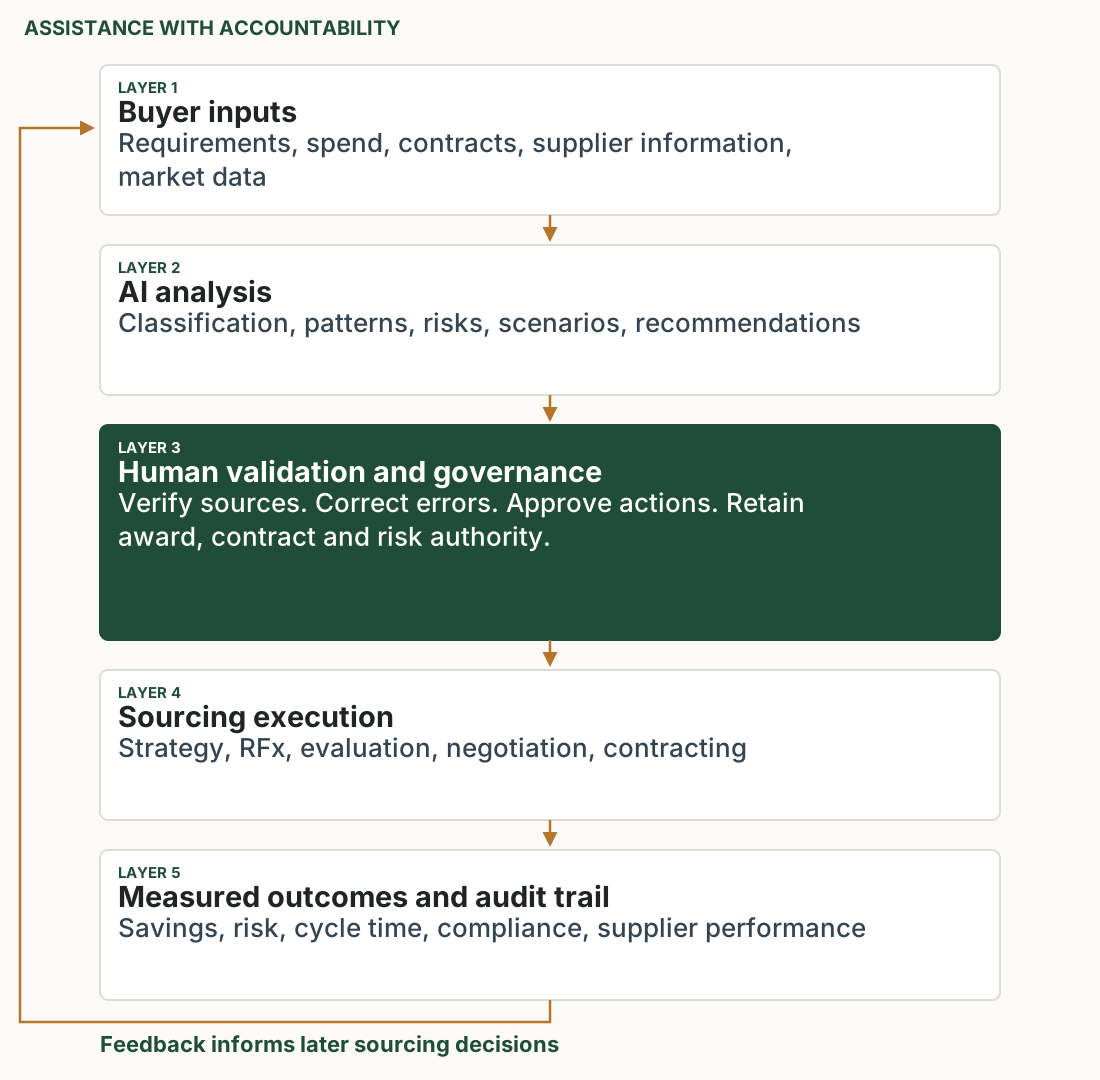
AI strategic sourcing means using machine-learning or generative systems to assist sourcing work while preserving accountable buyer decisions. Start with a bounded task and approved data. A useful output must be traceable enough for a reviewer to check, correct, or reject it.
Our five-layer workflow is an editorial operating model, not a certification. NIST’s AI Risk Management Framework core treats governance as cross-cutting and calls for defined human oversight roles. The sourcing controls below apply that general principle to buyer work.
Where AI can assist across the lifecycle
| Use case | Required input | Useful output | Human check |
|---|---|---|---|
| Spend classification | Invoices, supplier master, approved taxonomy | Proposed categories and unmatched items | Finance reviews exceptions and a representative sample. |
| Demand and requirements | Usage, forecasts, stakeholder notes | Draft requirement groups and demand scenarios | Owners confirm meaning, scope, and testability. |
| Supply-market research | Approved market sources with dates | Comparison of segments and constraints | Analyst opens sources and checks relevance and currency. |
| Supplier discovery | Requirements and candidate evidence | Candidate list with fit questions | Sourcing validates capability; missing evidence is not a disqualification by itself. |
| RFP drafting | Approved requirements and event rules | Draft questions and response structure | Sourcing removes leading or unnecessary requirements. |
| Proposal normalization | Permissioned responses and pricing sheets | Comparable fields and missing-data flags | Reviewer checks units, term, exclusions, and original passages. |
| Evaluation support | Fixed rubric and proposal evidence | Evidence excerpts and draft scoring rationale | Human evaluators own scores and resolve disagreements. |
| Pricing analysis | Comparable prices and demand assumptions | Cost scenarios and anomalies | Finance verifies arithmetic and comparability. |
| Negotiation preparation | Issues, alternatives, approved objectives | Options, questions, and concession scenarios | Negotiator controls commitments and communications. |
| Contract review | Approved contract text and clause guidance | Potential deviations and issue summaries | Qualified legal reviewers determine meaning and acceptable language. |
| Supplier-risk monitoring | Authorized alerts and source records | Signals requiring investigation | Risk owner validates the signal before adverse action. |
| Savings validation | Approved baseline and actual spend | Reconciliation and variance explanation | Finance signs off the attribution and realized amount. |
Use the full sourcing process to place each use case in context. Do not assume that a tool capable of summarizing a proposal is also reliable at pricing calculations, contract interpretation, or supplier-risk judgment. Test each task separately.
What AI should not decide independently
Retain human approval of sourcing strategy, supplier exclusion, material scoring judgments, award, commitments, contract terms, and risk acceptance. Drafting a recommendation is different from authorizing it. Review controls must apply before an action leaves the organization, not only after an automated workflow finishes.
- Require approval before supplier messages or RFx changes are sent.
- Keep security, privacy, and legal gates outside a model’s weighted recommendation.
- Restrict access by role and purpose; a sourcing user’s access to one event should not expose another event’s bids.
- Provide a practical human override and a manual fallback if the tool is unavailable or unreliable.
Data inputs, privacy, security, and procurement controls
Inventory the proposed data before selecting a tool: spend records, personal information, contracts, supplier submissions, market sources, and internal negotiation positions. Identify the owner, sensitivity, permitted use, access group, and retention requirement for each dataset. Use synthetic or approved redacted records for early pilots.
| Control | Buyer action | Evidence to retain |
|---|---|---|
| Purpose and access | Limit inputs to the approved task and authorized users. | Data inventory, permission design, and owner approval. |
| Supplier and model boundaries | Identify hosting, model providers, subprocessors, and data flows. | Reviewed architecture and contractual use restrictions. |
| Output validation | Require source locations, missing-data flags, and reviewer signoff. | Original input, model/version where available, output, corrections, and approval. |
| Retention and exit | Agree deletion, export, backup treatment, and offboarding responsibilities. | Retention schedule and tested export/deletion procedures. |
| Change control | Retest important tasks after model, prompt, taxonomy, or workflow changes. | Versioned test results, release decisions, and rollback route. |
These are review questions, not a universal legal checklist. The organization’s legal, privacy, and security owners determine applicable obligations and acceptable contractual terms.
Accuracy, bias, confidentiality, and hallucination
A fluent answer can contain unsupported facts. NIST’s Generative AI Profile identifies confabulation among generative-AI risks. For sourcing, require the reviewer to distinguish a source-supported statement from an inference or invented detail.
- Accuracy: independently reconcile totals, currencies, quantities, and dates. Test missing and contradictory inputs, not only clean examples.
- Bias: examine whether available data or prior awards systematically favor incumbents or well-documented suppliers. Ask whether a missing record is being mistaken for poor capability.
- Confidentiality: validate contractual data use, access restrictions, retention, and training settings before sharing bids or negotiation positions.
- Untrusted source instructions: treat supplier documents as evidence, not as authority to change the evaluation rubric or trigger actions. Test whether embedded instructions can redirect the workflow.
- Automation dependence: measure review effort and error severity. A fast draft that takes longer to verify may not improve the process.
Example: normalize proposals without automating the award
Illustrative workflow: a buyer receives three software proposals with different user metrics, migration fees, and support assumptions. The analyst uses an approved tool to extract each pricing element into a fixed template, recording the source page and any ambiguity. The tool must leave missing values blank rather than infer a price.
Finance checks every material cost line and recomputes three-year scenarios. Sourcing sends common clarification questions after human approval. Evaluators use the same preapproved rubric and retain their own rationale. Legal and security review their gates separately. The award committee receives the checked comparison, unresolved issues, and a record of AI use.
Pilot measures include extraction error rate by field, critical omissions, reviewer corrections, elapsed cycle time, and review hours. Savings, risk, compliance, and supplier performance are later business outcomes to measure against a baseline; they are not automatically caused by the AI tool.
Questions to ask AI sourcing vendors
- Data ownership and training: Who owns inputs and outputs? Are prompts, documents, or corrections used to train any model, and can that use be contractually prohibited?
- Confidentiality and security: How are tenants, roles, and sensitive event data separated? What security evidence and incident-notification commitments are available?
- Subprocessors and retention: Which providers receive data, where is it processed, how are changes notified, and how are records and backups deleted?
- Traceability and audit: Can a buyer export sources, versions, actions, reviewer corrections, and approvals in a usable format?
- Human override: Can approvals block external actions, reverse a workflow, and preserve a manual route? Demonstrate these controls.
- Accuracy testing: Will you test against our representative, permissioned examples? How are critical errors, uncertainty, and model changes handled?
- Output ownership and indemnification: What rights can we exercise in outputs, and what negotiated protection is available for relevant third-party claims? Have legal review exclusions and limitations.
- Performance commitments: Which functionality, service levels, support, remediation, and exit commitments will be written into the agreement rather than left in a demo?
AI sourcing readiness checklist
- One bounded use case, accountable owner, and manual baseline are defined.
- The inputs are authorized, classified, and limited to what the task needs.
- Representative test cases include missing, conflicting, and adversarial material.
- Acceptance criteria distinguish critical errors from cosmetic defects.
- Reviewers can inspect sources and have time and authority to reject outputs.
- Supplier communications and material decisions require human approval.
- Security, privacy, procurement, and legal review are complete for the intended use.
- Audit export, deletion, model-change handling, and fallback procedures are tested.
Use the tools selection guide to compare AI assistance with the underlying sourcing capabilities you actually need. Begin with the existing evidence and human-review methodology and approved starter-kit worksheets.
Frequently asked questions
Can AI choose the winning supplier?
It can help assemble evidence and draft comparisons. Accountable humans should validate the evidence, apply the approved criteria, and authorize the award.
Is AI sourcing the same as procurement automation?
No. Workflow automation may route approvals or move data without AI. AI introduces additional questions about inference, accuracy, traceability, and task-specific validation.
Can we upload supplier bids into a public chatbot?
Do not assume permission. Check the confidentiality obligations, approved tool environment, data use, access, and retention terms with the responsible owners first.
How should we measure value from an AI pilot?
Compare a defined task with its manual baseline, including review hours, error severity, cycle time, and rework. Do not count an unverified draft or projected saving as a realized outcome.