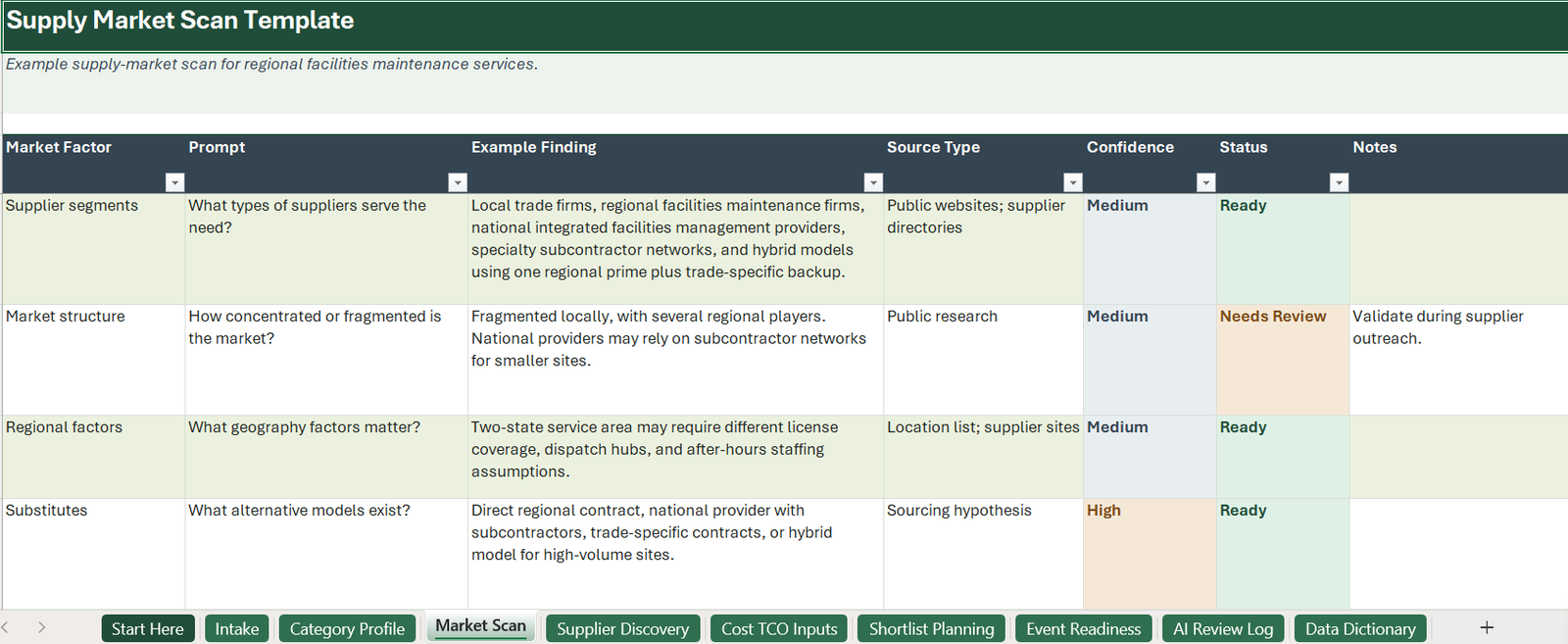
Supply market analysis uses supply market intelligence and supply market data to understand the supplier landscape, market structure and concentration, capacity constraints, geographic availability, substitutes, cost pressures, and sourcing risks. Source notes and confidence ratings make evidence quality visible.
Supply market intelligence is the structured collection and interpretation of external market information used to support sourcing decisions. It explains how a supplier market works, which options may be viable, and where the team needs stronger evidence before acting.
Useful intelligence covers supplier segments and capabilities, capacity and availability, geographic coverage, market concentration, and substitutes. It also considers cost and inflation drivers, relevant regulatory or geopolitical factors, technology shifts, and supplier operational or financial signals that warrant further review. A directory can identify names; intelligence connects those names and market conditions to the buyer's requirements.
Record the source, date, confidence level, and remaining information gaps for each material finding. Distinguish observed facts from supplier claims and working assumptions. The result is an input to category sourcing strategy: evidence for choosing a sourcing approach, testing alternatives, and deciding which questions to take to suppliers.
What Supply Market Data Should You Collect?
Supplier landscape: Major and emerging suppliers, capabilities, relevant segments, and market coverage.
Market structure: Fragmentation or concentration, barriers to entry, substitutes, and switching constraints.
Capacity and supply: Availability, lead times, geographic constraints, bottlenecks, and capacity signals.
Commercial factors: Cost drivers, pricing trends, labor and input pressures, and logistics exposure.
Risk: Concentration, geopolitical exposure, relevant regulation, and single-source dependencies.
Evidence quality: Source, date, reliability, confidence, assumptions, and information gaps.
Collect data that answers the sourcing question. Note where public information needs supplier validation rather than treating missing or dated evidence as a confirmed market condition.
How to Conduct a Supply Market Analysis
Define the sourcing question. Set the requirement, scope, geography, timing, and decision the research must support.
Identify relevant market segments. Separate supplier types and service or product models that could meet the need.
Gather supply market data. Capture relevant sources and dates in the market scan and evidence log.
Assess the supplier landscape. Compare capabilities, coverage, and concentration; use supplier discovery to investigate gaps.
Analyze capacity, constraints, and alternatives. Test availability, switching feasibility, geographic limits, and substitutes.
Evaluate cost and market pressures. Carry material drivers and assumptions into the Should-Cost / TCO playbook.
Document evidence quality and assumptions. Record confidence, conflicting sources, unresolved questions, and required specialist review.
Translate findings into sourcing decisions. Agree the next action and owner, then use the Supplier Shortlist playbook to document which options merit advancement.
The Full Sourcing Playbook System connects these findings with intake, strategy, cost review, and sourcing-event readiness.
When to use it
The supplier landscape is unclear.
Stakeholders are relying on familiar suppliers without market context.
A category decision depends on regional, capacity, or cost-driver conditions.
When it is not sufficient
It is not a full supplier evaluation, RFP scorecard, risk assessment, or legal/compliance review. It identifies market signals and evidence gaps that may require deeper specialist review.
Buyer-side decisions supported
Does sufficient competition exist, and does an RFP make sense now?
Is additional supplier discovery needed before defining a shortlist?
Do incumbents have unusual leverage, and is switching realistic?
Would timing change availability or negotiating leverage?
Which geographic or capacity constraints limit viable options?
What questions should be tested with suppliers, and what evidence is strong enough to support the next step?
Inputs required
Public supplier research
Industry directories
Stakeholder knowledge
Location or demand data
Cost-driver hypotheses
Known constraints
Included artifacts
Market scan worksheet
Supplier segment map
Evidence quality notes
Open-question tracker
Regional factor log
Example prompts and questions
Is the market fragmented or concentrated?
Are national providers using subcontractor networks?
What substitutes or alternate models exist?
Which claims need validation?
Illustrative use case
Illustrative example: for facilities maintenance, the market scan separates local trade firms, regional providers, national IFM providers, specialty networks, and hybrid models, then records confidence and evidence gaps for each market factor.
Common mistakes
Copying public supplier claims without source notes.
Treating a search summary as verified market intelligence.
Ignoring local capacity and after-hours constraints.
Not separating facts from hypotheses.
Frequently asked questions
Should AI be used for market scans?
AI can help summarize and compare approved source material, but a person should review sources and remove unsupported claims.
Is this a supplier risk tool?
No. It can flag risk questions, but formal supplier risk belongs in a separate review process.
Use the starter kit, then request the full sourcing playbook overview.
The free kit shows the workflow. The full package discussion can cover team use, advisory use, category-specific adaptations, and implementation support.