Buyer-side resource
Strategic Sourcing Examples: Completed Buyer-Side Scenarios
These completed buyer-side scenarios show how requirements, market evidence, evaluation, negotiation, and delivery constraints lead to a sourcing recommendation. Every scenario is illustrative, with assumptions made explicit.
What a completed sourcing example should demonstrate
A useful strategic sourcing example shows how a buyer moves from a business problem to an evidence-based choice, including the tradeoffs, contract priorities, and delivery conditions. A finished scorecard without the underlying assumptions does not explain the decision.
All scenarios, suppliers, prices, scores, and outcomes below are constructed illustrations. They are not customer engagements, market benchmarks, vendor quotations, or claims of achieved savings. Amounts are illustrative USD assumptions. The examples demonstrate decisions; the existing workbook examples page remains the place for worksheet fields, screenshots, and downloadable preparation assets.
Completed enterprise software sourcing example

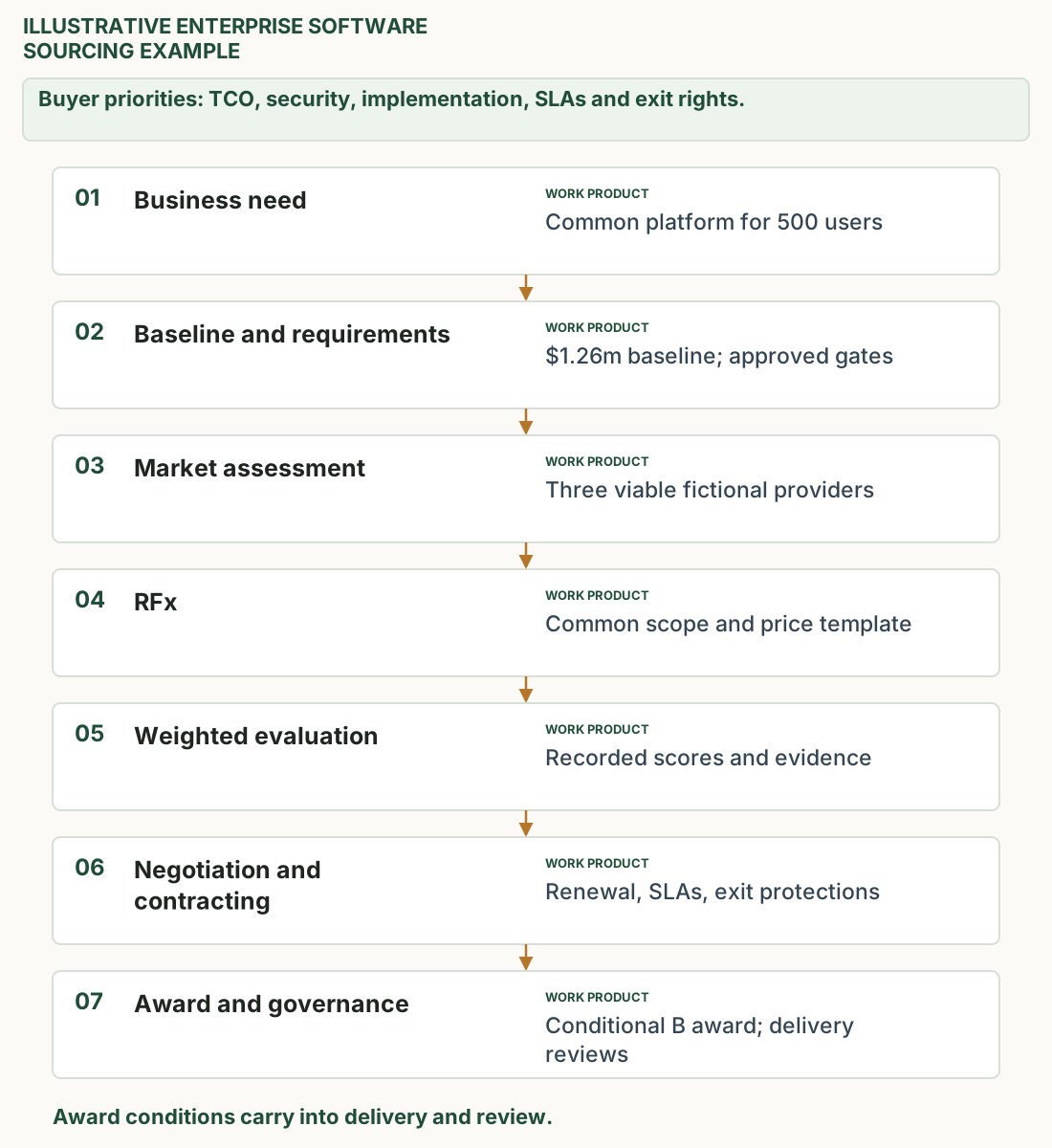
Business need: a fictional organization wants one service-management platform for 500 users across several locations. It needs consistent routing and reporting without interrupting existing support. The planning horizon is three years. The business sponsor approves phased implementation and a common test script.
| Decision element | Completed illustrative entry |
|---|---|
| Objective | Meet mandatory service workflows and security requirements while keeping evaluated three-year TCO at or below $1.20 million. |
| Baseline | Current recurring cost is assumed to be $420,000 per year, or $1.26 million over three years at unchanged scope. This is a comparison baseline, not a market rate. |
| Requirements | 500 users; identity integration; reporting; usable data export; migration acceptance; documented support escalation; approved security and privacy review. |
| Market assessment | Three fictional providers pass an initial capability screen. A is the incumbent with lower transition disruption; B offers a viable phased migration; C has lower cost but an unresolved implementation dependency. |
| RFx approach | Common scope, pricing template, workflow demonstration, implementation plan, and proposed agreement. Clarifications are shared consistently. |
| Mandatory gates | All three are assumed to pass the initial security and export gates. Any later material exception returns to the designated reviewer before award. |
The market assessment is deliberately separate from supplier marketing. The team asks each provider to demonstrate the required workflow and validate implementation resources. The incumbent’s familiarity is an execution advantage, but it does not excuse an uncompetitive offer or weak renewal terms.
Normalize the three-year cost comparison
| Cost assumption | Supplier A | Supplier B | Supplier C |
|---|---|---|---|
| Subscription over 3 years | $990,000 | $900,000 | $840,000 |
| Implementation and migration | $60,000 | $120,000 | $160,000 |
| Internal change and training | $30,000 | $60,000 | $70,000 |
| Dual running and exit allowance | $30,000 | $60,000 | $50,000 |
| Evaluated 3-year TCO | $1,110,000 | $1,140,000 | $1,120,000 |
Subscription includes the required support in this example. Taxes, financing effects, and inflation are excluded for simplicity, not assumed irrelevant in a real decision. The buyer must validate entitlement definitions, integrations, usage growth, and exit effort. TCO is an evaluated scenario, not a fixed supplier invoice.
Supplier B’s $1.14 million scenario is $120,000 below the $1.26 million baseline, approximately 9.5%. That is a modeled difference, not realized savings: legacy shutdown, demand, implementation cost, and actual invoices determine what is achieved. If B’s dual-running allowance increases by $120,000, its TCO reaches the baseline and exceeds the $1.20 million planning ceiling. The team would reopen the plan.
Weighted evaluation and evidence
| Criterion | Weight | A score | B score | C score |
|---|---|---|---|---|
| Workflow and functional fit | 30% | 4 | 4 | 3 |
| Evaluated TCO | 25% | 5 | 3 | 4 |
| Implementation feasibility | 25% | 4 | 5 | 2 |
| Support and service model | 20% | 3 | 4 | 3 |
| Weighted result out of 5 | 100% | 4.05 | 4.00 | 3.00 |
The example rubric uses 1 = weak, 3 = acceptable, and 5 = strong, with intermediate scores allowed. TCO bands were set before bids: at or below $1.11m earns 5; above $1.11m through $1.12m earns 4; above $1.12m through $1.15m earns 3; above $1.15m through $1.20m earns 2; above $1.20m earns 1 and requires sponsor review of affordability. These bands are scenario assumptions, not a recommended universal rubric.
For non-cost criteria, evaluators record supporting observations. A’s existing environment reduces migration uncertainty; B’s named implementation team and accepted phased plan support its implementation score. C’s unresolved dependency reduces feasibility. Weighted scores organize the evidence but do not authorize an award or cancel a mandatory gate.
Negotiation priorities and award recommendation
The initial evaluation narrowly favors A. The sourcing team therefore uses a documented clarification and best-offer stage rather than changing the weights to select B. The priorities are renewal pricing, migration acceptance, service remedies, data export, termination rights, and transition assistance. All suppliers receive the same opportunity to address the relevant requirements.
Illustrative final finding: A will not agree to the buyer’s required renewal-price protection. Legal and the sponsor classify that unresolved deviation as unacceptable under the approved commercial requirements. B closes the required terms without changing the modeled price. C retains its implementation dependency. The decision record retains the original scores and explains the post-evaluation contractual finding.
Award recommendation: approve B at an evaluated $1.14 million three-year TCO, conditional on the final agreement, security/privacy closure, an accepted migration plan, and authorized signature. B’s $30,000 premium over A buys an acceptable contractual position and a stronger demonstrated implementation plan in this scenario. If those conditions fail, return to the sponsor rather than silently treating B as awarded.
Implementation and governance: the service owner signs off migration milestones; finance validates invoices and legacy retirement; sourcing records renewal deadlines; quarterly reviews examine adoption, service levels, incidents, and the cost forecast. Exit rights are supported by a practical export and transition plan, not merely a clause heading.
SaaS renewal example: rightsize before the notice date
Illustrative situation: a team has 800 licensed seats but measures 620 active users. It forecasts 50 additional users and identifies 30 seats needed for resilience or approved exceptions. The initial planning quantity is therefore 700 seats, subject to business validation; 180 inactive seats do not automatically equal 180 removable seats.
The buyer checks notice deadlines, minimum commitments, license reassignment, bundles, and alternative products. It compares a 700-seat renewal, an 800-seat commitment with protections, and a phased replacement. Negotiation priorities include pricing at the chosen volume, renewal caps, a growth-rate schedule, and the ability to reduce at the next renewal.
Recommendation: renew at 700 seats only if the contractual minimum permits it and the agreed economics exceed the switching case after transition cost. Assign quarterly usage review and a named notice-date owner. If the supplier refuses rightsizing, the approved fallback is an evaluated short extension while replacement feasibility is tested—not an invented threat to switch overnight.
Managed-services example: buy a measurable service
Illustrative situation: a business wants consolidated application support, but incumbent statements of work mix incidents, minor enhancements, and project work. The buyer first separates these demand types, defines service hours, and validates historic volumes. The market comparison distinguishes a dedicated team, a shared service, and a hybrid model.
Evaluation tests transition staffing, knowledge transfer, escalation, reporting, and service measurement. Pricing scenarios include baseline workload and an agreed higher-volume case; the team checks what is excluded and how changes are priced. Negotiation connects service levels to measurable obligations and addresses subcontracting, key-person dependence, termination, and transition assistance.
Recommendation: select the provider with the validated transition team and transparent demand bands, conditional on scope closure and service acceptance criteria. The service owner reviews incidents and improvement actions monthly. See the existing IT sourcing preparation demonstration for the upstream worksheet approach.
Hardware and infrastructure example: availability is part of value
Illustrative situation: a buyer needs a refresh across multiple locations. It confirms configurations, installation windows, spares, warranty coverage, and retirement responsibilities before requesting bids. Market research tests authorized supply routes, delivery commitments, and support availability for the intended service period.
The comparison includes equipment, freight, installation, support, spare stock, and disposal assumptions. A lower quoted unit price is not equivalent if it changes the configuration or misses the deployment window. Technical reviewers validate equivalence; supplier-risk reviewers assess dependencies and continuity questions.
Recommendation: split the rollout into approved delivery waves when that fits operational capacity, with payment and acceptance tied to documented delivery obligations. Retain a contingency source only after checking configuration and support compatibility. Review defects, lead times, and warranty performance to inform the next refresh.
What these examples teach
- State the requirement and decision rule before seeing preferred suppliers’ proposals.
- Show the baseline, units, scope, and exclusions behind a cost comparison.
- Distinguish a score from an award and an award from authority to sign.
- Record a contractual disqualification transparently rather than manipulating scores.
- Treat switching effort, internal capacity, and service continuity as real costs and constraints.
- Separate modeled opportunity from finance-validated results.
Use the seven-step process for sequencing and the five-pillar framework for connected decision questions. Prepare the evidence with the Category Sourcing Strategy Playbook, Supplier Shortlist Playbook, and TCO worksheets. Download the existing blank starter workbook or inspect the completed worksheet previews to organize your own assumptions.
Frequently asked questions
Are these real customer examples?
No. All scenarios, suppliers, prices, and scores are constructed illustrations. They show reasoning and tradeoffs without claiming client results or market benchmarks.
Must the highest-scoring supplier win?
Follow the approved decision rules. Mandatory gates and unresolved contractual requirements may prevent award. Record the reason and approval rather than changing scores to justify a preference.
Is the lowest subscription price the lowest-cost option?
Not necessarily. Include implementation, internal change, dual running, usage assumptions, support, and exit costs on a comparable basis.
Where are the worksheet examples and downloads?
The existing workbook examples page and Starter Kit remain the resources for worksheet screenshots and editable preparation assets. These scenarios explain full lifecycle decisions rather than replace those resources.