Examples

Workbook examples for buyer-side sourcing preparation.

These screenshots show the completed starter-kit workbook with practical sourcing fields, review columns, and workbook tabs visible.

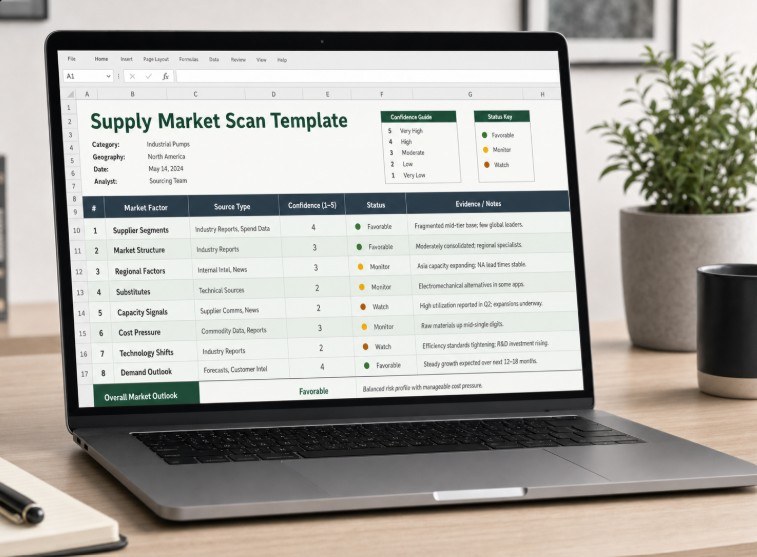
Laptop showing a Supply Market Scan Template worksheet in the Sourcing Playbooks color palette

Screenshots

Real worksheet views, not decorative mockups.

Each screenshot shows how the worksheet supports a specific decision or review point before later bidding, contracting, renewal, or vendor-management activity.

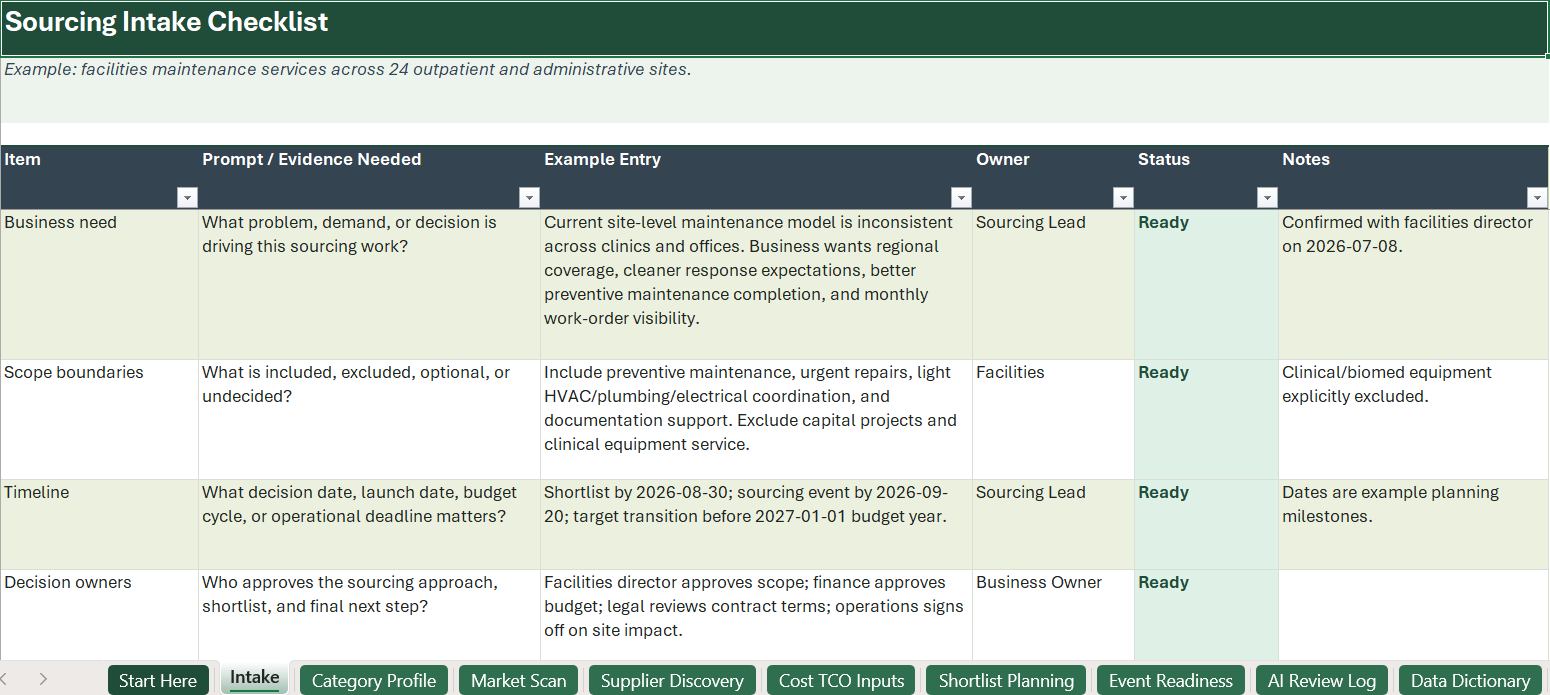
Sourcing Intake Checklist workbook screenshot with example rows, owner, status, notes, and worksheet tabs visible Enlarge preview

Sourcing Intake Checklist

Clarifies: Business need, scope boundaries, timing, decision owners, known constraints, source material, and readiness gates.

Supports: Whether the request is ready for market scan and supplier discovery.

Useful fields: Owner, status, notes, evidence prompts, and example entries make it a reviewable sourcing packet rather than a blank form.
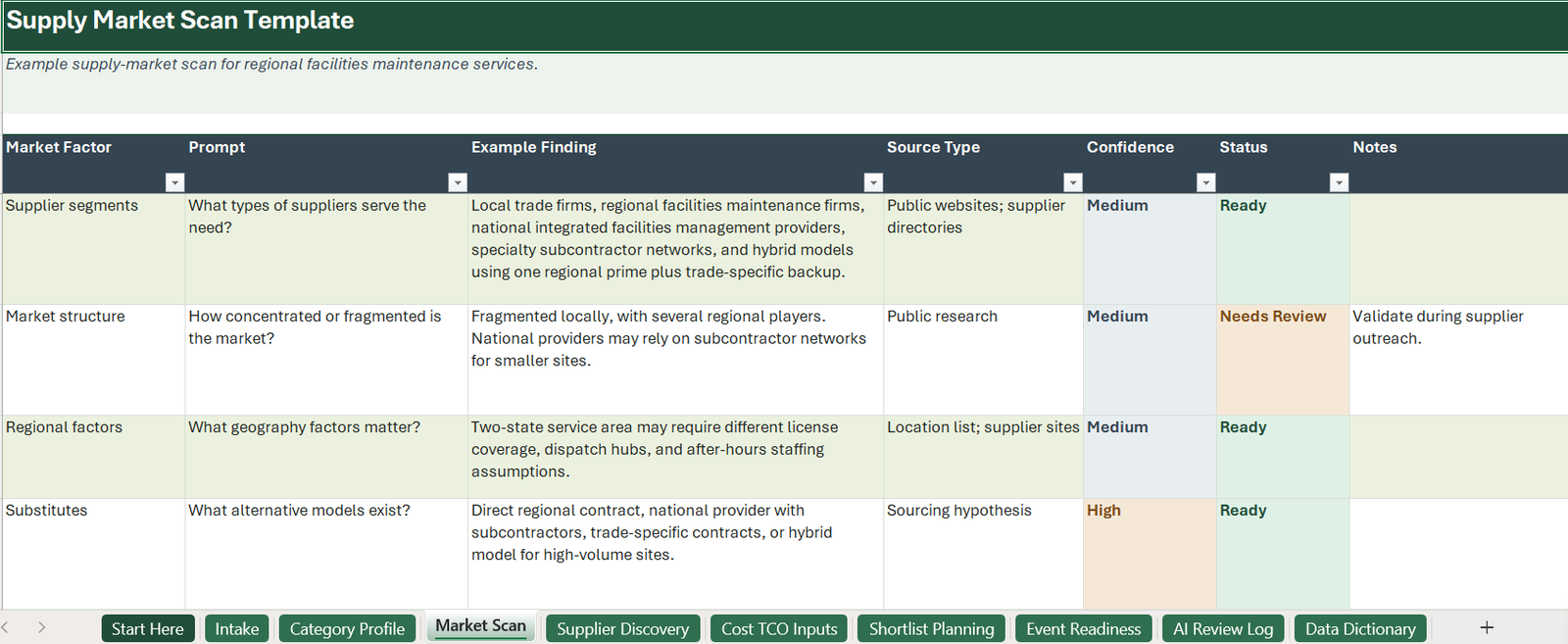
Supply Market Scan Template workbook screenshot with market factors, example findings, confidence, status, and worksheet tabs visible Enlarge preview

Supply Market Scan Template

Clarifies: Supplier segments, market structure, regional factors, substitutes, capacity signals, cost pressure, and evidence quality.

Supports: Whether the team has enough market intelligence before supplier outreach.

Useful fields: Source type, confidence, status, and notes help separate observed evidence from assumptions.

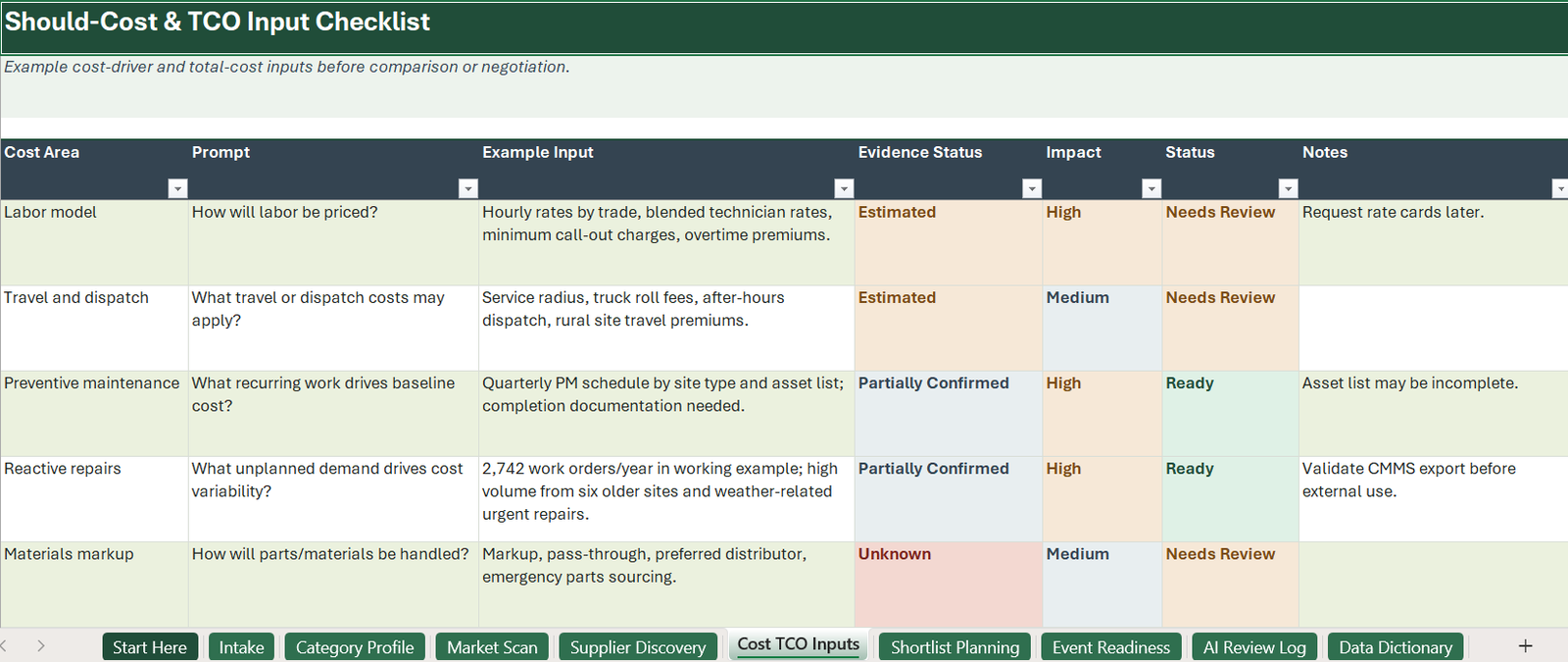
Should-Cost and TCO Input Checklist workbook screenshot with evidence status, impact, readiness, notes, and worksheet tabs visible Enlarge preview

Should-Cost & TCO Input Checklist

Clarifies: Labor model, travel and dispatch, preventive maintenance, reactive repairs, materials markup, reporting, and switching friction.

Supports: Whether cost-driver assumptions are ready for finance review before shortlist approval.

Useful fields: Evidence status, impact, readiness, and notes show which costs are known, estimated, or still unresolved.

Illustrative scenarios

How the worksheets might be used.

These are generic business-side examples, not verified customer stories or customer claims.

Illustrative sourcing scenario

Category lead preparing a facilities maintenance sourcing project

Situation
A category lead needs to prepare a regional facilities maintenance sourcing project across multiple business sites before supplier outreach begins.
Worksheet used
Sourcing Intake Checklist
What it clarified
The worksheet clarifies included services, excluded clinical or biomedical equipment, site coverage, response expectations, decision owners, and approved source material.
Human-review point
Facilities leadership confirms scope while finance validates spend context and legal is identified for later contract review.
Next sourcing step
Move into category profile and supply-market scan once the intake gate is ready.
Example sourcing scenario

Sourcing analyst building a market scan before outreach

Situation
A sourcing analyst has stakeholder referrals and public supplier research but needs a structured view of the market before contacting suppliers.
Worksheet used
Supply Market Scan Template
What it clarified
The worksheet separates local trade firms, regional providers, national integrated facilities providers, specialty networks, confidence ratings, and evidence gaps.
Human-review point
The sourcing lead reviews source quality and removes unsupported supplier claims before discovery work advances.
Next sourcing step
Build the supplier discovery grid and identify which suppliers need validation calls.
How this worksheet might be used

Finance partner reviewing cost-driver assumptions

Situation
A finance partner wants to understand whether visible supplier pricing will reflect total cost before shortlist approval.
Worksheet used
Should-Cost & TCO Input Checklist
What it clarified
The worksheet identifies labor rates, travel premiums, preventive maintenance, reactive repair volume, materials markup, reporting work, and switching friction.
Human-review point
Finance reviews which costs are validated, estimated, unknown, or vendor-provided before the shortlist rationale is approved.
Next sourcing step
Update shortlist planning with cost-driver questions and unresolved assumptions.

Category demonstration

See a fictional IT sourcing example.

The IT sourcing demonstration shows how the same preparation workflow can be applied to a software support and managed services category without using confidential supplier, employer, or customer data.

Next step

Use the starter kit, then request the full sourcing playbook overview.

The free kit shows the workflow. The full package discussion can cover team use, advisory use, category-specific adaptations, and implementation support.