Buyer-side resource
Strategic Sourcing Tools: Categories, Comparison and Buyer Selection Guide
Choose strategic sourcing tools around the work your team needs to perform. Compare the capabilities, data, controls, and operating costs that turn a sourcing task into a reliable buyer decision.
Tool-category map

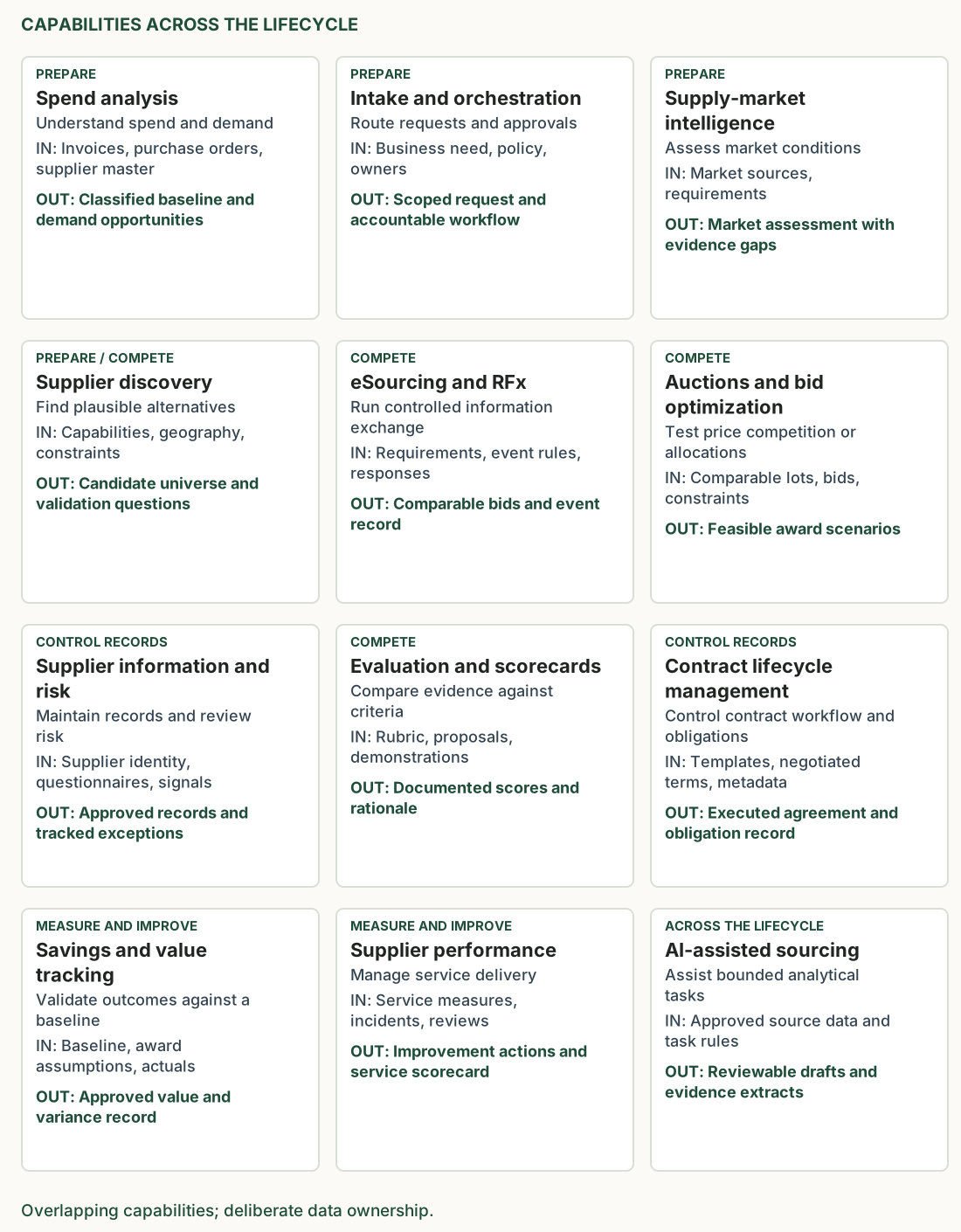
Strategic sourcing tools help buyers prepare, execute, and govern sourcing decisions. The term includes spreadsheets and templates as well as specialized applications and broad software suites. A useful comparison starts with the decision and work product, then asks which capabilities and integrations are necessary.
| Category | Primary purpose | Required input | Buyer output | Typical role |
|---|---|---|---|---|
| Spend analysis | Understand spend and demand | Invoices, purchase orders, supplier master | Classified baseline and demand opportunities | Intelligence |
| Intake and orchestration | Route requests and approvals | Business need, policy, owners | Scoped request and accountable workflow | Execution |
| Supply-market intelligence | Assess market conditions | Market sources, requirements | Market assessment with evidence gaps | Intelligence |
| Supplier discovery | Find plausible alternatives | Capabilities, geography, constraints | Candidate universe and validation questions | Intelligence |
| eSourcing and RFx | Run controlled information exchange | Requirements, event rules, responses | Comparable bids and event record | Execution |
| Auctions and bid optimization | Test price competition or allocations | Comparable lots, bids, constraints | Feasible award scenarios | Execution / intelligence |
| Supplier information and risk | Maintain records and review risk | Supplier identity, questionnaires, signals | Approved records and tracked exceptions | Record / intelligence |
| Evaluation and scorecards | Compare evidence against criteria | Rubric, proposals, demonstrations | Documented scores and rationale | Execution |
| Contract lifecycle management | Control contract workflow and obligations | Templates, negotiated terms, metadata | Executed agreement and obligation record | Record / execution |
| Savings and value tracking | Validate outcomes against a baseline | Baseline, award assumptions, actuals | Approved value and variance record | Record / intelligence |
| Supplier performance | Manage service delivery | Service measures, incidents, reviews | Improvement actions and service scorecard | Record / execution |
| AI-assisted sourcing | Assist bounded analytical tasks | Approved source data and task rules | Reviewable drafts and evidence extracts | Intelligence / execution |
These are functional categories, not mutually exclusive product markets. A suite may cover several, and two licensed products may duplicate the same capability. “Record,” “intelligence,” and “execution” describe roles in your architecture; they do not establish which application is authoritative for every dataset.
Tools, templates, and software platforms
A template standardizes what a person records: requirements, cost assumptions, evidence, or an approval. A tool performs a task such as bid normalization. A platform connects multiple tasks, users, permissions, and records. More modules do not automatically produce a more coherent process.
| Approach | Appropriate use | Limits to evaluate |
|---|---|---|
| Templates and spreadsheets | A bounded event with manageable collaboration and review needs. | Version control, permissions, audit history, formula review, and manual handoffs. |
| Specialist application | A recurring bottleneck such as complex bid allocation or supplier-risk review. | Interfaces, duplicated records, ownership, and dependency on a narrow provider. |
| Integrated platform | Repeated events with many users, approvals, and connected records. | Implementation effort, configurability, total cost, adoption, and exit complexity. |
The Sourcing Strategy Starter Kit is a preparation resource. It is not represented as a substitute for an enterprise event platform, supplier-risk system, or contract repository.
Match the use case before choosing software
- Unclear spend: prioritize supplier normalization, classification review, and reconciliation before advanced sourcing analytics.
- Requests bypass procurement: improve intake routing, ownership, and response expectations; adding an RFx module alone may not address the problem.
- Inconsistent bids: test response templates, units, clarification handling, and scenario comparisons.
- Complex award allocation: consider optimization only when constraints and comparable bid data can be represented accurately.
- Renewals discovered late: test contract metadata quality, notice alerts, and accountable renewal ownership.
- Unverified savings: connect the baseline, award, invoices, and finance validation rather than relying on a dashboard estimate.
Auctions need a suitable competitive situation and clear comparability. A price mechanism cannot resolve an ambiguous service scope, an unacceptable transition risk, or a supplier’s inability to deliver.
Required integrations and data
| Connection | What to establish | Acceptance test |
|---|---|---|
| ERP, AP, and supplier master | Authoritative IDs, currencies, tax treatment, and refresh timing. | Reconcile a sample of transactions through the full pipeline. |
| Identity and access | User provisioning, role boundaries, single sign-on, and removal. | Disable a test user and verify access ends across connected modules. |
| Contracts and documents | Versions, metadata, signatures, retention, and permissions. | Retrieve the executed agreement and its correct notice date. |
| Risk and supplier records | Ownership of findings, evidence dates, and exception status. | Update a finding and confirm affected events show the right status. |
| APIs and exports | Rate limits, licensed connectors, retry behavior, and data portability. | Export usable event data and recover from an interrupted transfer. |
Specify error ownership. If a supplier record fails to synchronize, decide who investigates, how the failure is surfaced, and whether sourcing can continue. Include connector fees, data cleansing, internal support, and ongoing administration in TCO.
Buyer-side comparison checklist
Set mandatory gates first, then score the capabilities that differentiate viable options. Use the same scripts, sample data, and evaluators for each vendor. Record what was demonstrated, documented, promised, or unavailable.
- Workflow fit: can users complete the actual sourcing task without parallel spreadsheets?
- Data quality: can the buyer inspect, correct, reconcile, and export records?
- Auditability: are original submissions, changes, approvals, and rationale retained?
- Security and privacy: do access, hosting, retention, and data-use arrangements meet the approved requirements?
- Integration: are needed interfaces available, supported, and included in the price?
- Implementation: are responsibilities, migration scope, acceptance criteria, and training explicit?
- Economics: are users, suppliers, events, transactions, storage, AI consumption, and services priced clearly?
- Contract and exit: are renewal, changes, support, export, transition, and deletion addressed?
For a pilot, ask an analyst to normalize a messy bid and a reviewer to locate the original evidence. Ask an administrator to change a rule and show the audit record. A polished vendor-led demonstration should not be treated as proof of your team’s operating experience.
Questions to ask sourcing-tool vendors
- Which required workflows are native, configured, custom-built, or dependent on a partner?
- What data must be cleaned before implementation, and who owns that work?
- Which connectors and API usage are included, and what costs or limits apply?
- Can we export original submissions, scoring rationale, attachments, approval history, and configuration?
- How are product changes, service incidents, and security findings communicated?
- What implementation assumptions could change the price or schedule?
- What evidence will establish acceptance, and what happens if acceptance fails?
- What changes at renewal: price, minimum commitment, bundles, features, or support?
- How are AI inputs, outputs, training use, and model changes handled?
The AI strategic sourcing guide provides a fuller set of AI-specific questions. For supplier due diligence, CISA’s vendor and supplier assessment resource offers a structured starting point for ICT supply-chain questions; adapt it to your risk review.
Build versus buy
Build when a narrow, stable requirement can be maintained with the organization’s available engineering, security, and support capacity. Buy when established functionality and support justify the subscription and implementation effort. Configure an existing system when it can meet the requirement without creating a fragile customization burden.
Compare three-year operating scenarios, not only initial license versus development cost. Include maintenance, testing, security updates, data stewardship, workflow changes, user support, integration failures, and employee turnover. A spreadsheet also has a maintenance owner, even if its cost is hidden in someone’s time.
Use a pilot to test the uncertainty most likely to change the decision. For example, validate whether the existing platform can preserve the required bid audit trail before procuring another platform for that purpose.
Common software-buying mistakes
- Buying a suite before deciding which workflow problem matters.
- Counting roadmap features as current capabilities without an explicit delivery commitment.
- Ignoring the buyer’s configuration, data, and administration effort.
- Assuming an API listing proves a working integration.
- Double-counting benefits from overlapping modules.
- Using a generic “best tools” ranking instead of a tested fit against requirements.
This guide does not rank vendors or imply hands-on product testing. Its selection criteria are buyer-side editorial guidance. Map capabilities to the sourcing process and use TCO worksheets to document cost assumptions.
Frequently asked questions
What are the best strategic sourcing tools?
The best fit depends on the workflow, data, users, controls, and operating constraints. Use common demonstration scripts and documented criteria instead of a universal vendor ranking.
Can spreadsheets be strategic sourcing tools?
Yes. They can support structured preparation and comparison. Evaluate access, auditability, version control, scale, and maintenance before using them for a critical workflow.
Do we need an integrated sourcing suite?
Not always. An existing platform plus a specialist capability may be sufficient. Compare integration and administration effort as well as license cost.
Should AI be a mandatory requirement?
Only when a defined use case and validation plan justify it. Core workflow reliability, evidence access, and human approval may matter more than the presence of an AI feature.